SpaceX Wants to Buy Boost Mobile: Musk’s Plan to Turn Starlink Into a Full US Carrier

SpaceX is in talks to buy Boost Mobile, the discount mobile carrier owned by EchoStar, as Elon Musk moves to turn Starlink into a full mobile network in the United States. The Washington Post reported on 2 November 2026 that SpaceX has held talks in recent months about acquiring Boost Mobile or gaining access to its network, with Musk discussing the idea personally with EchoStar chairman Charlie Ergen in October. Neither company has commented publicly, and no terms or agreement have been reported.
The talks are the latest step in a rapid build-out. On 4 November, Reuters reported that Qualcomm signed a multi-year agreement to supply radio equipment, baseband units and software for Starlink Mobile’s planned nationwide terrestrial 5G network. Qualcomm described the deal as its biggest 5G contract yet, although neither company disclosed its financial value.
SpaceX Boost Mobile Talks: What Is Actually on the Table
| Fact | Detail |
|---|---|
| Reported talks | SpaceX in discussions with EchoStar to buy Boost Mobile or gain network access (Washington Post, 2 Nov 2026) |
| People involved | Elon Musk met EchoStar chairman Charlie Ergen in October 2026, according to the report |
| Status | Unconfirmed — neither SpaceX nor EchoStar has commented; no terms or agreement reported |
| Boost Mobile subscribers | About 7.19 million at the end of Q3 2026 |
| Spectrum already held | About $17 billion of EchoStar spectrum bought in September 2025, plus a further $8 billion agreed in October 2026 |
| Equipment partner | Qualcomm multi-year deal, 4 Nov 2026 — “Dragonwing radio and baseband platforms” |
| Rollout target | Nationwide deployment to begin in 2027, across tens of thousands of cell sites |
| Rival carriers | AT&T, Verizon and T-Mobile, each with more than 100 million subscribers |
| Addressable market | About $235 billion, according to equity research firm MoffettNathanson |
Boost Mobile ended the third quarter of 2026 with roughly 7.19 million wireless subscribers, a small figure next to the more than 100 million subscribers each claimed by AT&T, T-Mobile and Verizon. Boost owns no cell towers of its own. It operates as a mobile virtual network operator, leasing capacity from AT&T and T-Mobile and reselling it under its own brand.
That structure shapes what a deal could deliver. SpaceX could buy Boost Mobile outright, taking on the brand, its customer base, its billing systems and its retail distribution. Alternatively, it could strike an arrangement that gives it access to the network Boost leases, without necessarily owning the customer relationship. Either route would hand Starlink Mobile a ready-made retail brand and subscriber base on day one.
Why Musk Wants a Carrier of His Own
Musk has spent most of 2026 asking the three largest US wireless carriers for something they have shown no interest in giving him: access to their networks so SpaceX could launch a mobile service of its own. According to reporting from The Washington Post, Musk approached AT&T, T-Mobile and Verizon about buying capacity, and all three declined to strike a direct deal.
The Boost Mobile talks are a different way in. At the Baron Investment Conference on 6 November, Musk said SpaceX could acquire a legacy wireless carrier and use its licensed airwaves far more efficiently than the current owner. He named no target, filed no paperwork and made no commitment to a timeline. “We could just acquire that legacy telco and use their spectrum, you know, ten times more effectively,” Musk told the conference by video.
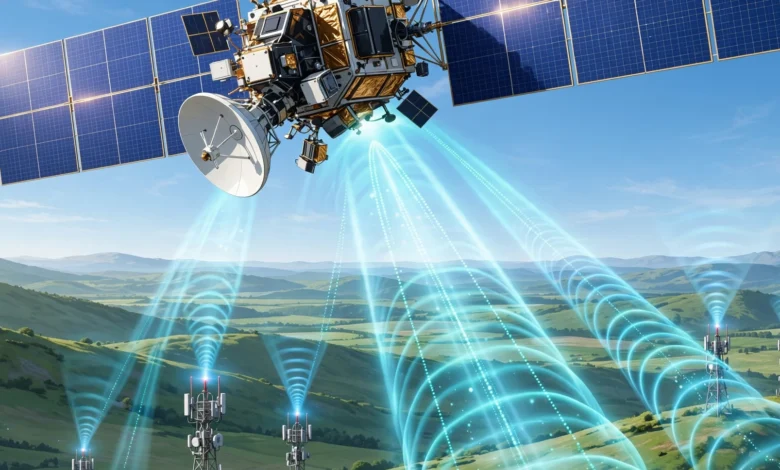
The ambition is a hybrid satellite-terrestrial network under the Starlink Mobile name, in which satellites handle coverage outdoors and in remote areas while ordinary cell towers handle everything else. SpaceX’s chief financial officer Bret Johnsen has described the goal as building a network that keeps people connected on their phones no matter where they are. The company’s direct-to-cell satellites are already in orbit, and the wider constellation stands at more than 13,000 satellites launched.
The Spectrum Puzzle Is Mostly Assembled
Spectrum is the most concrete part of the build-out. Spectrum is the set of radio frequencies a carrier is licensed to use, and SpaceX has spent heavily to assemble its holding: In September 2025, SpaceX agreed to buy wireless spectrum licences from EchoStar for approximately $17 billion, structured as up to $8.5 billion in cash and up to $8.5 billion in SpaceX stock, with SpaceX also covering close to $2 billion of EchoStar’s bond interest through November 2027.
The package included AWS-4, AWS-H Block and unpaired AWS-3 frequencies, the mid-band airwaves best suited to carrying mobile data. The Federal Communications Commission approved the EchoStar transfers in May 2026 as part of a combined $40 billion transaction. SpaceX then agreed in October 2026 to buy a further $8 billion of spectrum licences tailored for service in places satellites cannot reach.
Deutsche Telekom chief executive Tim Höttges put SpaceX’s total spectrum holding at roughly 79 MHz of low- and mid-band airwaves on the company’s 5 November earnings call. He said he takes the plan “super serious”, while estimating that the build-out could cost Musk more than $200 billion. SpaceX has also agreed to acquire a portfolio of nationwide 800 MHz licences, with that deal expected to close in the first half of 2027.
The Qualcomm Deal Gives Starlink Mobile Its Ground Game
The Qualcomm agreement was the first detailed piece of the terrestrial puzzle. Reuters reported on 4 November 2026 that the chipmaker will supply radio equipment, baseband units and software for Starlink Mobile’s planned nationwide terrestrial 5G network. The deal covers the Dragonwing radio and baseband platforms, which are designed to connect millions of phones on the ground to the satellite network. Qualcomm described the agreement as its biggest 5G contract yet, though it gave no financial details. The deal matters because a satellite network alone cannot deliver a mobile service. Phones need ground infrastructure — cell towers, base stations and the software that manages them — and Qualcomm is supplying the core of it. SpaceX has said it plans to deploy the equipment across tens of thousands of cell sites.
What the Carriers Say
The US mobile market is the largest single-country revenue pool in the world. It generates roughly $235 billion a year in mobile service revenue, according to equity research firm MoffettNathanson. AT&T’s chief financial officer said at the end of October that the business is “very competitive”. Verizon, meanwhile, has seen its stock fall by more than 50% since the start of 2021.
T-Mobile’s CEO, meanwhile, dismissed SpaceX’s plan to take its spectrum from satellite to phone, telling investors the company is “in no position to build a terrestrial network”. He added that T-Mobile “welcomes any new entrant that brings real investment”, before returning to the point: “No one should get a free ride on spectrum.”
What Happens Next
SpaceX has not confirmed a deal, and EchoStar has not commented. But the pieces are moving quickly: spectrum bought, a Qualcomm deal signed, a launch target set and now a retail carrier in the frame. If the Boost Mobile talks turn into a deal, Starlink Mobile will arrive not as a satellite add-on but as a full carrier — and the US mobile market will have a fourth player with ambitions far beyond its 7.19 million subscribers.
FAQs
Q: Is SpaceX buying Boost Mobile?
A: Not yet. SpaceX is reported to be in talks with EchoStar about buying Boost Mobile or gaining access to its network. Neither company has confirmed the talks, and no terms or agreement have been reported.
Q: What is Starlink Mobile?
A: Starlink Mobile is SpaceX’s planned mobile network, combining its direct-to-cell satellites with a terrestrial 5G network built with Qualcomm equipment. Nationwide deployment is targeted to begin in 2027.
Q: How many subscribers does Boost Mobile have?
A: About 7.19 million wireless subscribers at the end of Q3 2026.
Q: How much spectrum has SpaceX bought?
A: About $17 billion of EchoStar spectrum in September 2025, plus a further $8 billion agreed in October 2026, alongside a portfolio of nationwide 800 MHz licences.
Q: When will Starlink Mobile launch?
A: SpaceX is targeting nationwide deployment from 2027, with the 800 MHz spectrum deal expected to close in the first half of that year.